- Your cart is empty Browse Shop
Hotel acoustics: the best treatment in the house is often the building
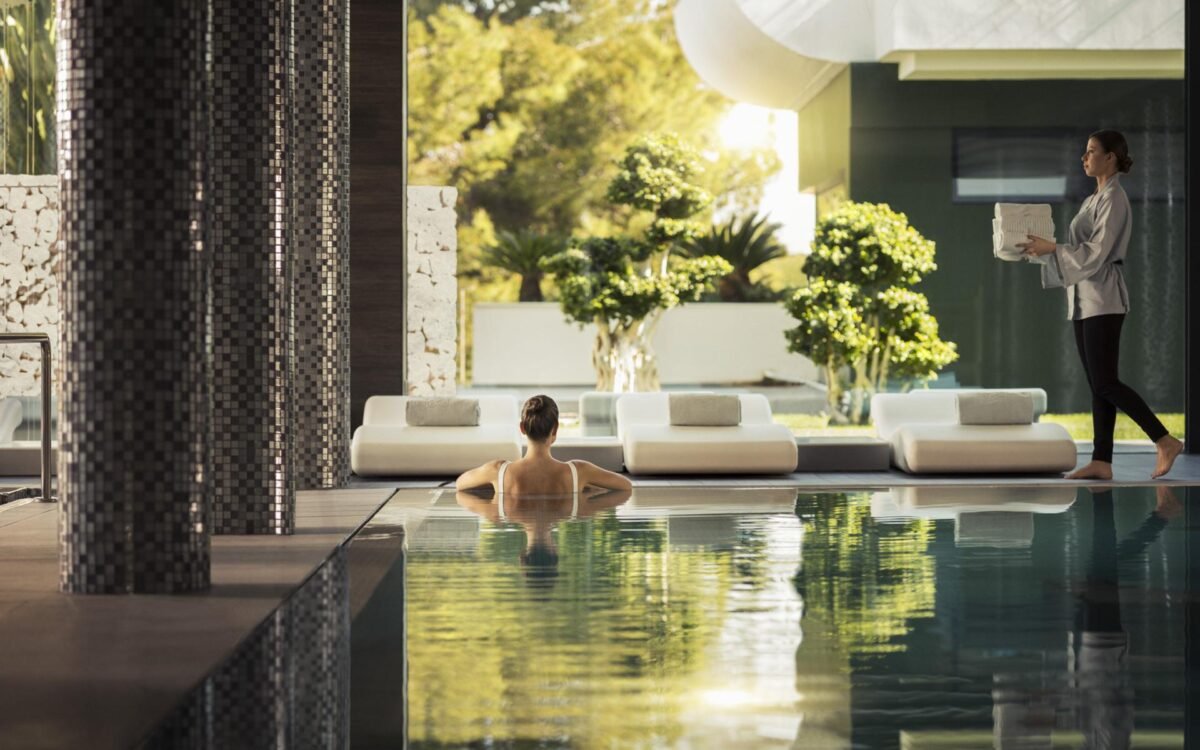
When I arrive on a project, I am shown the treatment rooms first. What I look at first is the evening light, the sound level and the temperature of the bedrooms. This is not a consultant’s affectation: it is where the strongest evidence in our profession lies.
In short
- The best-documented lever in wellness is silence — and no brochure mentions it.
- Ordinary indoor light in the evening is enough to cut melatonin by about 70%.
- The right test of a supplier: do they distinguish ordinary lux from melanopic lux?
- Best sleep sits between 20 and 25 °C, and falling asleep begins with the hands and feet.
- Plants do not purify the air; scent and music improve the lived experience, not the measurements.
There is an asymmetry in our sector that never stops surprising me.
The most cited study in all of health architecture — the 1984 one showing that surgical patients with a view of trees leave hospital earlier — covers forty-six patients. Forty-six. We all cite it, myself included.
Meanwhile, noise has precise WHO thresholds, and the European Environment Agency attributes to it the equivalent of a million healthy life-years lost every year in Europe.
The best-documented domain in wellness is silence. And it is the one no brochure talks about.
What I look at, in order
Evening light
Ordinary indoor light, even soft, is enough to reduce melatonin by about 70%. Reference values now exist: plenty of light in the morning, very little in the three hours before bed. I always ask a supplier which units they use. When they do not distinguish ordinary lux from melanopic lux — the one the body clock actually perceives — I know who I am talking to.
Night-time sound level
Not the spa’s: the bedrooms’, the service corridors’, the ventilation plant’s, the street’s.
Temperature
Best sleep sits between twenty and twenty-five degrees. And one design detail that is always overlooked: falling asleep begins with the warming of the hands and feet. The thermal comfort of the bed counts as much as the room setpoint.
Ventilation
The Harvard figure on air and clarity is everywhere, and it rests on twenty-four participants — I cite it with that reservation. The formulation I defend is more sober: ventilation is a determinant of comfort and mental clarity, and CO² is its cheapest indicator.
What I remove from the sales deck
Plants presented as air purifiers. A reanalysis of thirty years of studies concludes that it would take hundreds per square metre to match one open window. Their value is aesthetic and psychological — it is real, and it is amply enough.
And therapeutic claims about scent and music. The Cochrane review on music and sleep is admirably honest: perceived quality improves, and the measuring devices see nothing change. On essential oils, a blinded trial will never be possible — you cannot mask a smell.
None of this makes me remove a single olfactory note from a journey. In hospitality, the lived experience is the product. But I do not sell it as a treatment. These are two sentences that can coexist, provided they are never confused.
Why I care so much
Because this is the pillar where sensoriality and rigour stop opposing each other.
I spent my career between houses betting on atmosphere and management teams asking for figures. For a long time this was presented to me as a trade-off. It is not one. Light, sound, temperature and air make both the beauty of a place and the solidity of what can be said about it.
That is why I treat design as a protocol, never as decoration. A material, a light, a silence are not the dressing around the treatment. They are part of it — and often, they do more than it does.
Read next: what I stopped promising after a treatment and designing a high-performance wellness concept.
A project in design? This is the right moment to set these variables. Contact me — or browse the Journal.
Further reading
- Evening light and melatonin — Journal of Clinical Endocrinology & Metabolism, 2011
- Reference values for light exposure — international consensus, PLOS Biology, 2022
- The health cost of noise in Europe — European Environment Agency, 2020
- A view of nature and recovery after surgery — Ulrich, Science, 1984
- Music and sleep — Cochrane review, 2022
Popular Posts