- Your cart is empty Browse Shop
Perimenopause: the decade when everything accelerates
This is the subject on which I have revised my certainties the most. Not because women in this decade need nothing — quite the opposite — but because most of what our profession offers them is not supported by the data.
In short
- Between 45 and 55, bone loses close to 10% in a decade and fat mass rises twice as fast, even at stable weight.
- The Menopause Society does not recommend, for hot flushes, most of the « menopause » offer our sector sells.
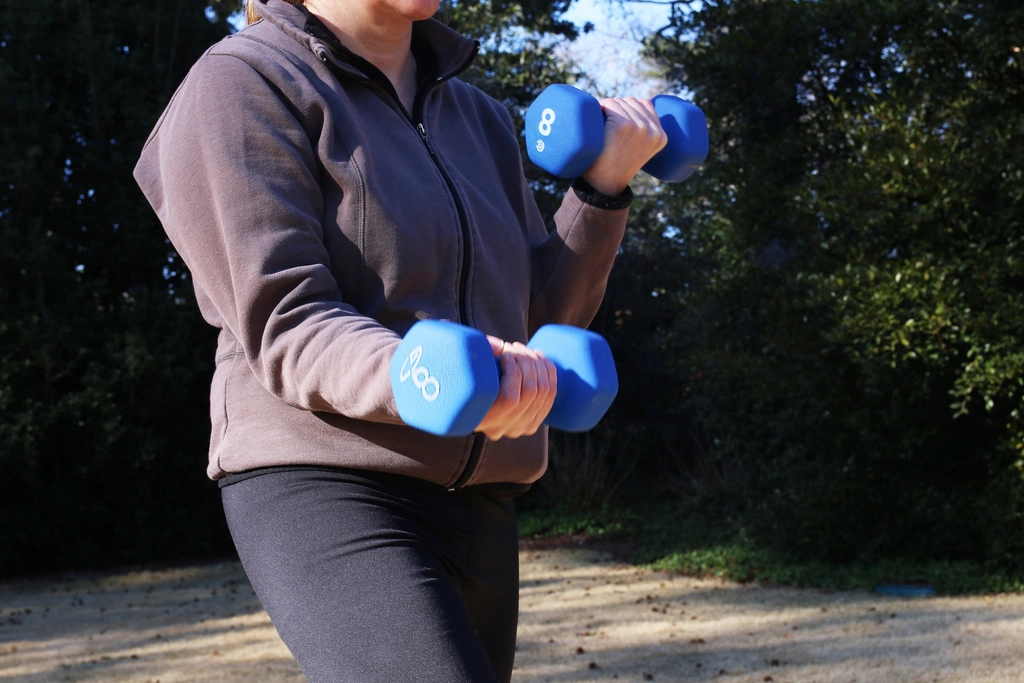
- What holds up: two supervised strength sessions a week, structured sleep support, regular movement.
- Hormone therapy is a matter for a physician: no prescribing, no dosing, no supplements.
- Only 7% of perimenopausal women meet physical activity guidelines.
Let us start with what is not in dispute
Between forty-five and fifty-five, something accelerates. Bone begins to give way about a year before the final period, at close to 2% a year — nearly 10% over a decade. Fat mass increases almost twice as fast as before, while muscle recedes. And this happens even at stable weight, which makes the scale frankly unfair at this age.
Cholesterol rises, and the American Heart Association attributes that rise to menopause more than to age. Cardiovascular disease is the leading cause of death among women worldwide, and the major Lancet commission describes it as under-diagnosed and under-treated in women.
That is a window. Real, documented, and closing.
And here is what I found when looking for what to offer
The official position statement of The Menopause Society, published in 2023, lists as not recommended for hot flushes: exercise, yoga, paced respiration, cooling techniques, mindfulness, dietary modification, relaxation techniques, supplements.
Which is, give or take, the entirety of the « menopause » offer sold by our sector.
I write this without pleasure. I have myself worked in houses offering these programmes, with sincere and competent teams. But you cannot claim an evidence-based approach and ignore a document of that nature.

What does hold up. And it is beautiful.
An Australian trial followed a hundred and one postmenopausal women averaging sixty-five years of age, whose bone was already compromised. Two supervised thirty-minute sessions a week, for eight months, at genuine intensity. They regained bone density where the control group lost it. Nine in ten completed the programme.
Two sessions a week. That is little. But « supervised » and « at genuine intensity » are not details — they are exactly what is missing in most of the gyms I audit.
Then sleep support. Among a hundred and fifty postmenopausal women with insomnia, behavioural treatment restored normal sleep in more than half of them, against one in twenty-five with simple hygiene advice. It is the most striking gap I have encountered in this literature.
And regular movement, even modest. Among nearly nine hundred women followed for twenty years, a slight increase in activity — walking first — slows bone loss.
The line I do not cross
Hormone therapy is a matter for a physician. It remains the most effective treatment for hot flushes, and the major 2024 reappraisal is equally clear: it is not prescribed to prevent cardiovascular disease, cancer or dementia.
A wellness house does not prescribe, does not dose, does not interpret a hormone panel, promises no « rebalancing » and does not sell menopause supplements. Knowing whom to refer to, and telling the guest, is part of the product. I see it as a mark of seriousness, never an admission of weakness.
Why I think this is the subject of the next five years
One figure stopped me: only 7% of perimenopausal women meet physical activity guidelines. Another: in the United States, fewer than a third of gynaecology training programmes include menopause teaching, while more than nine directors in ten believe there should be one.
A large, demanding clientele, poorly supported on both sides. A house offering an honest journey today — strength, sleep, energy, clear medical referral, no promises on hot flushes — stands out immediately.
In five years, it will be the norm. Today, it is still a position to take.
Read next: the recovery circuit I dismantle and what I stopped promising after a treatment.
Working on a journey dedicated to women’s health? It is a subject I follow closely. Contact me — or browse the Journal.
Further reading
- Menopause, its milestones and its management — Lancet series, 2024
- Menopause and cardiovascular risk — American Heart Association, Circulation, 2020
- Strength training and bone density — LIFTMOR trial, Journal of Bone and Mineral Research, 2018
- Non-hormonal approaches to hot flushes — The Menopause Society, 2023
- Hormone therapy: what it treats and what it does not prevent — reappraisal, JAMA, 2024
Popular Posts